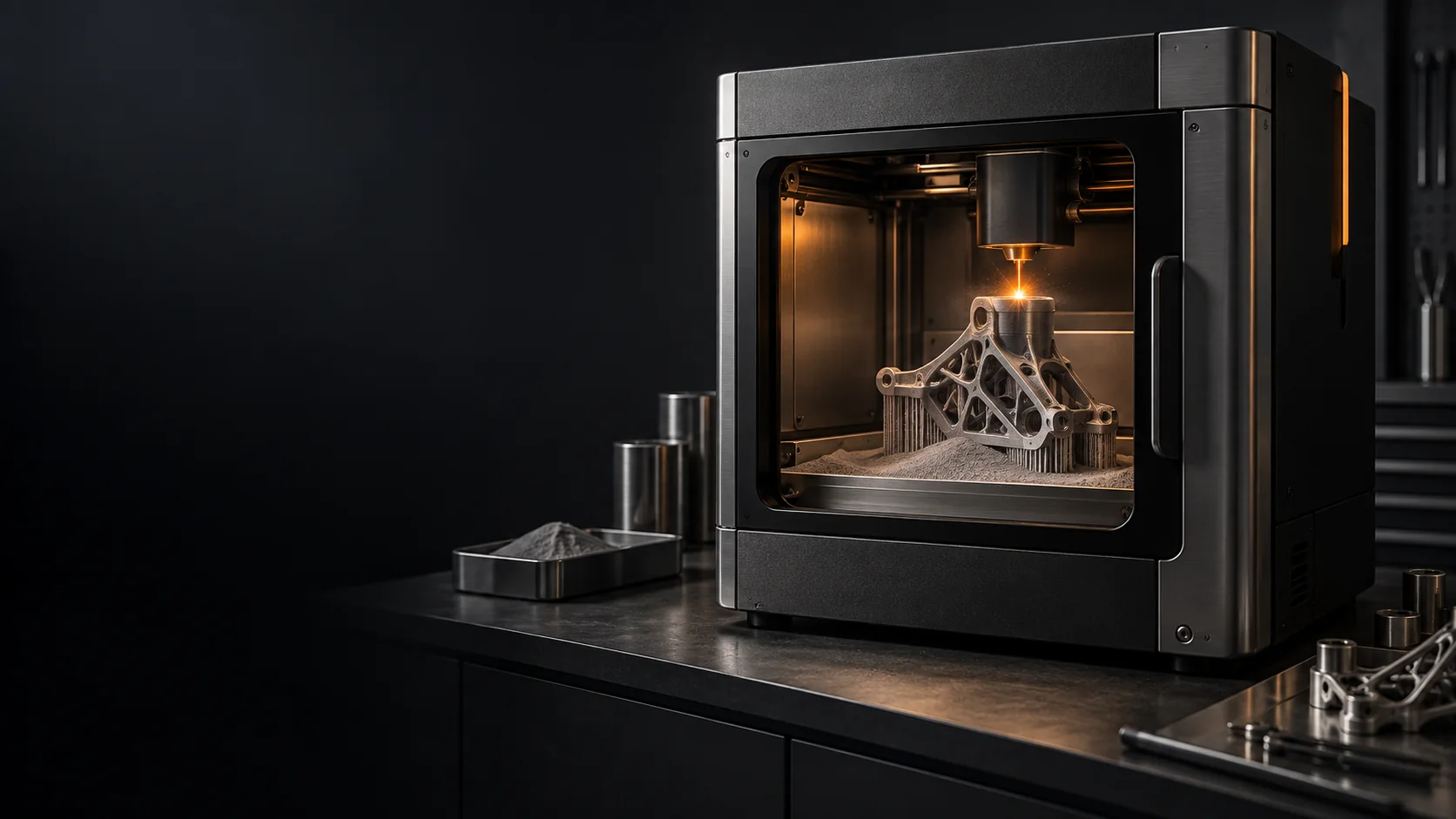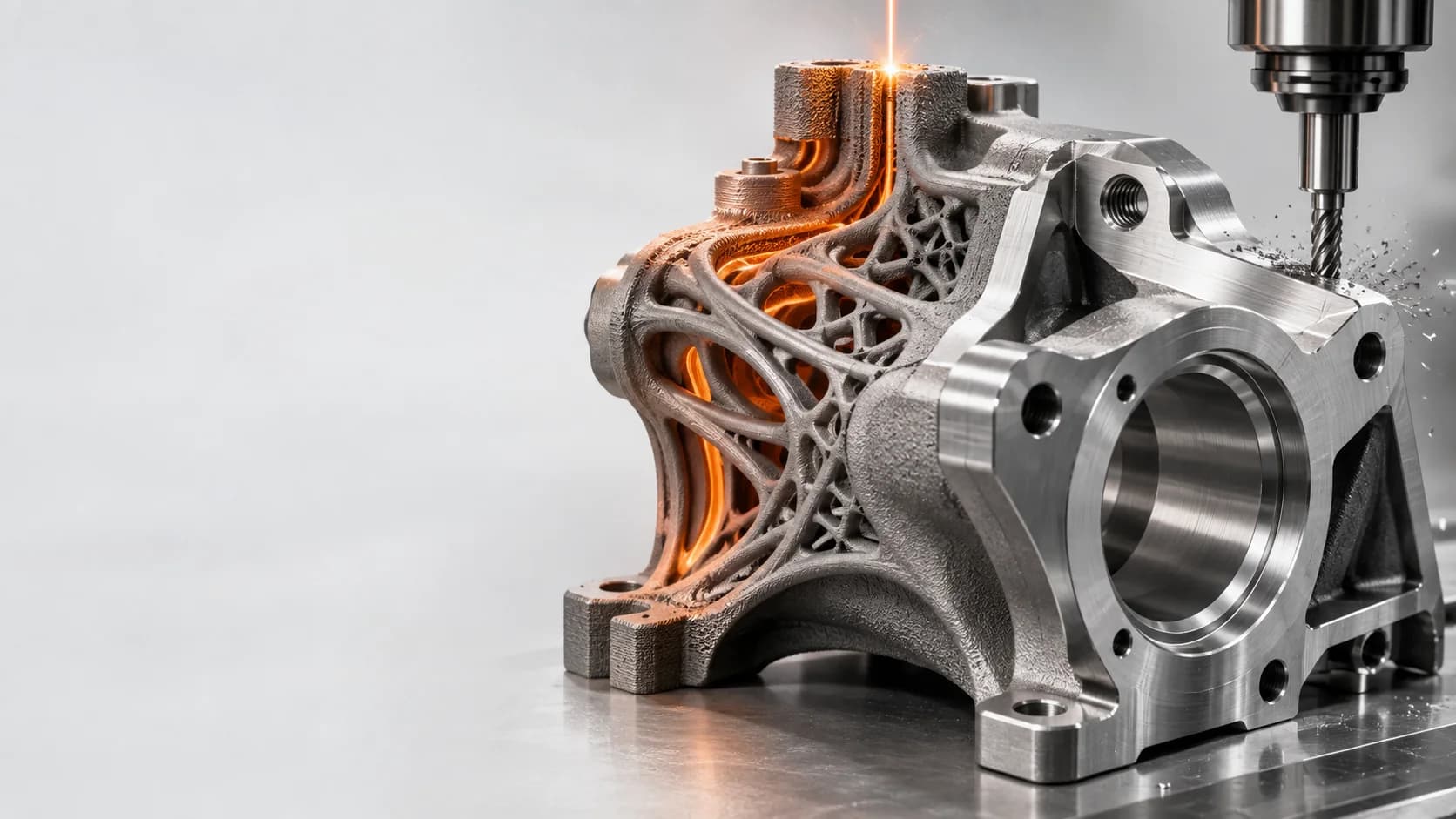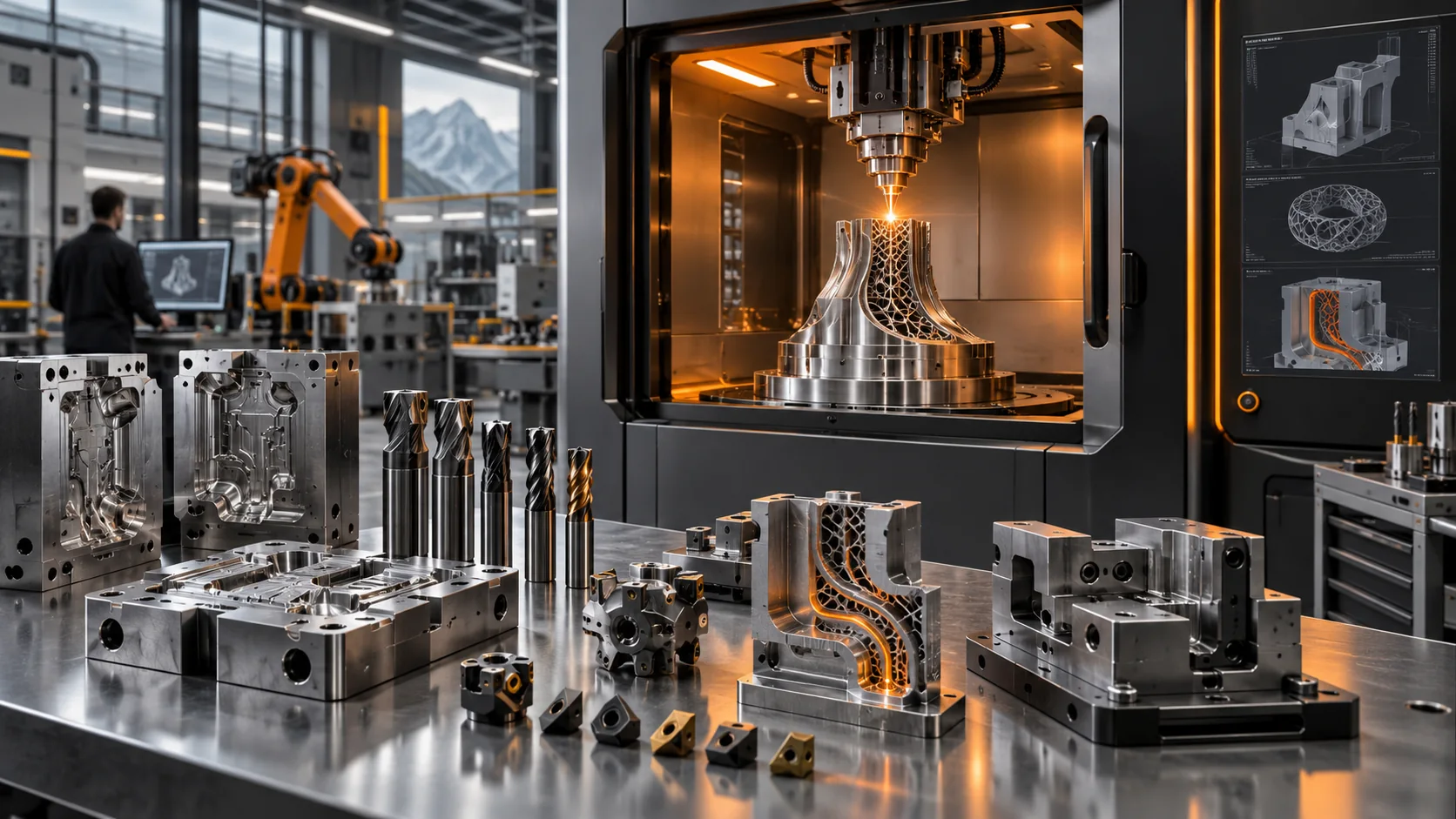
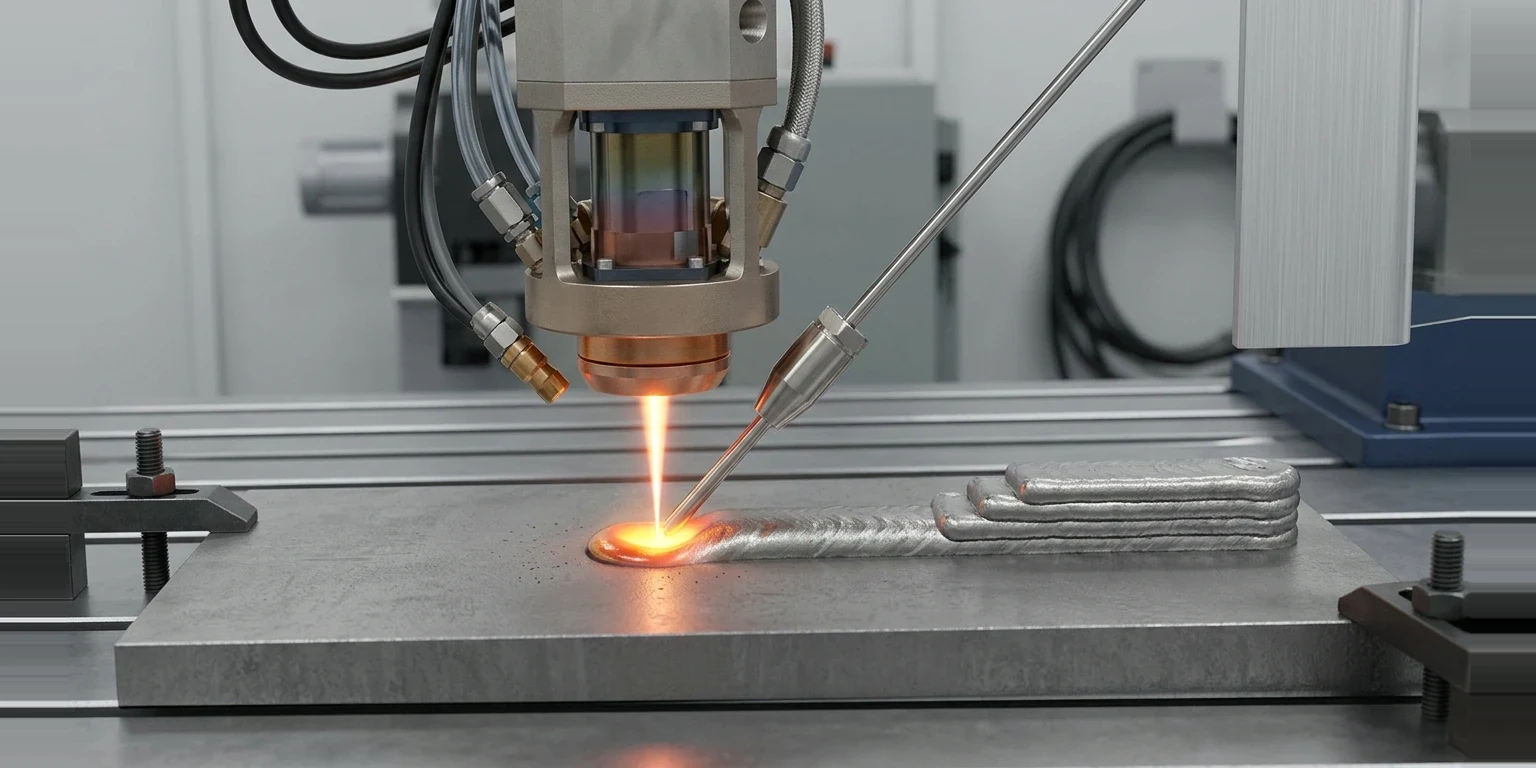
Metal 3D printing is often pictured as a laser moving over a bed of fine metal powder. That is one important method, but it is not the only way to build metal parts additively.
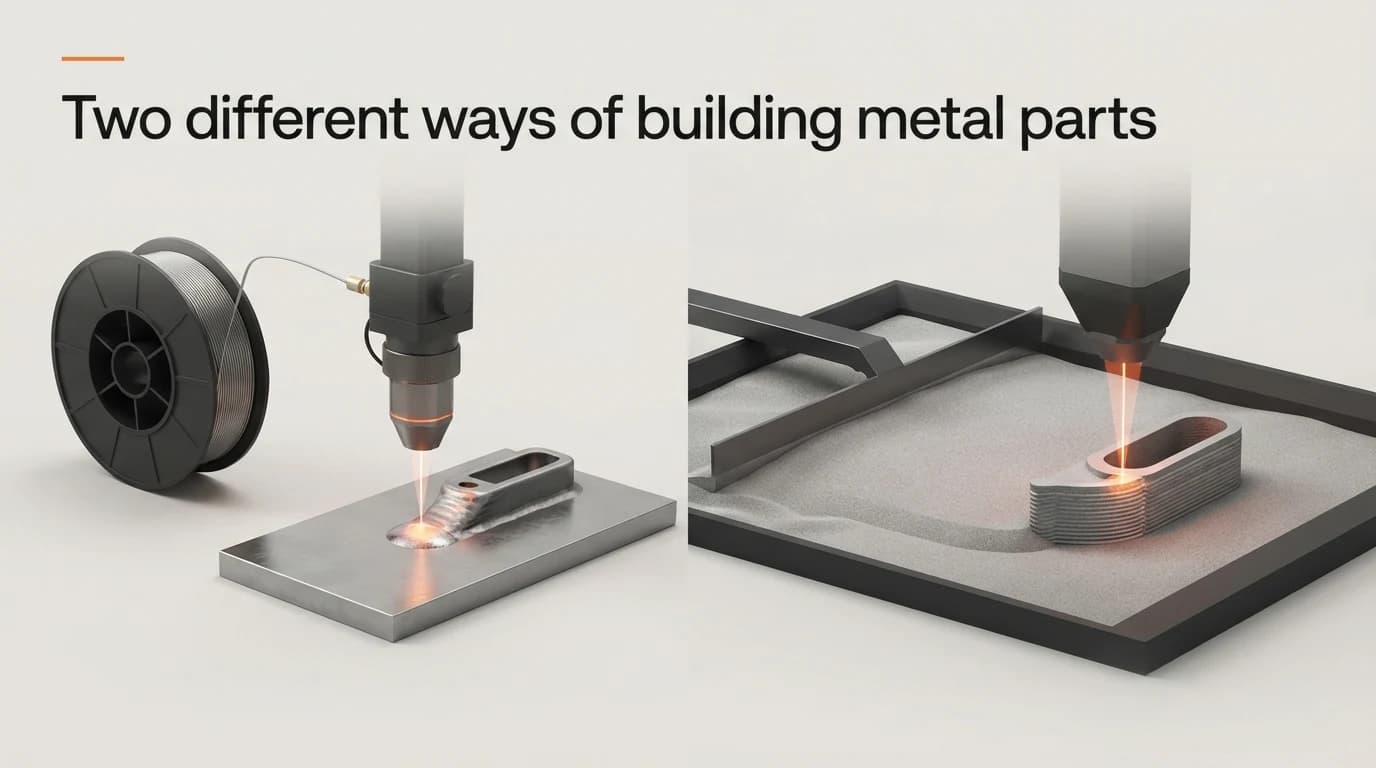
Directed energy deposition, usually shortened to DED, takes a different approach. Instead of spreading material across an entire build area first, a DED system delivers metal directly into a melt pool at the point where it is needed. The feedstock may be wire or powder, while the heat can come from a laser, electric arc or electron beam.
Think of it as laying down a controlled line of molten metal. The machine creates a small melt pool, feeds metal into it and follows a programmed path. Tracks are placed beside and above one another until the required shape is built.
That gives DED capabilities powder-bed systems generally lack, including adding material to an existing component and building near-net shapes for later machining. At the same time, DED usually cannot match Laser Powder Bed Fusion (L-PBF) for very fine features or intricate internal geometry.
What Is Directed Energy Deposition (DED)?
Directed energy deposition is a metal additive manufacturing process in which focused thermal energy melts material as it is being deposited onto a surface, following the terminology used in ISO/ASTM 52900, the international vocabulary standard for additive manufacturing. In plain terms, the heat source and the fresh metal meet at the same point during the build.
A typical DED setup includes an energy source, a wire or powder feed system, a motion system, a substrate or existing component, suitable shielding or environmental control, and software that creates the deposition path.
The result is usually a near-net shape rather than a finished part: the geometry is close to the final form but may still need machining, heat treatment, inspection or surface finishing.
Take a worn shaft with material missing from one area. Manufacturing a complete new shaft may be unnecessary. A suitable DED process can add metal only where it has been lost, after which the surface can be machined back to size. Depositing metal exactly where it is needed is one reason DED is used for repair, cladding, research, prototyping and larger components.
You may also see names such as Laser Metal Deposition (LMD), Laser Engineered Net Shaping (LENS) and Direct Metal Deposition (DMD), especially for laser-based powder DED, while WAAM is the arc-and-wire branch of the family. These terms overlap, but they do not always describe the same machine setup or feedstock route.
How Does the Directed Energy Deposition Process Work?
The machine layout changes between laser, arc and electron-beam systems, but the basic process is similar.
1. Prepare the model and deposition path
The process begins with a CAD model or a defined repair area. Build-preparation software converts the geometry into paths that tell the machine where material should be deposited. Planning has to consider the width and height of each bead, bead overlap, layer height, direction changes and access around the part.
2. Create the melt pool
The energy source heats a small region of the substrate or the previously deposited layer until a melt pool forms. Depending on the system, that heat comes from a laser, an electric arc or an electron beam.
3. Feed the material
Metal wire or powder is delivered into the heated zone. In wire DED the feed rate has to work with the available heat and travel speed: too much wire for the available heat causes incomplete melting or wire stubbing, where the incoming wire stays partly unmelted and contacts the deposited surface, while too little material produces an unstable or undersized bead.
4. Move and build the shape
The head or the workpiece follows the programmed path. Molten metal solidifies behind the melt pool and creates a track. Adjacent tracks form a layer, and further layers build the required height.
5. Manage heat between layers
DED repeatedly heats material that has already been deposited, and that thermal history affects distortion, residual stress, bead shape and microstructure. Builds therefore use controlled pauses, interpass temperature limits or adjusted path strategies.
6. Finish and inspect
The component may then need machining, grinding, heat treatment or inspection. DED should be judged as a complete manufacturing route, not only by the speed at which metal is deposited.
What Are the Main Types of Directed Energy Deposition?
DED is a process family rather than one machine design. The main differences come from the energy source and the feedstock.
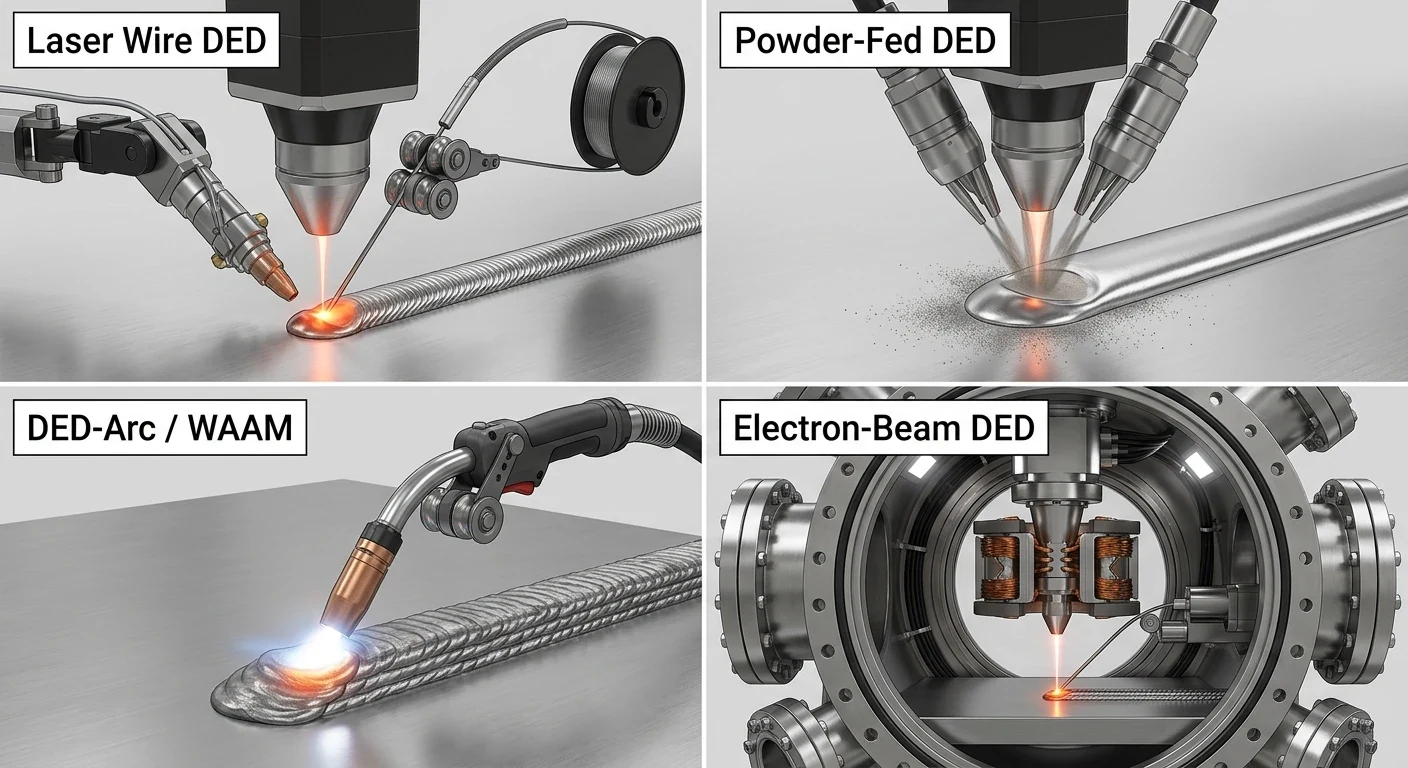
| DED type | Energy source | Feedstock | Typical strengths |
|---|---|---|---|
| Laser wire DED | Laser | Metal wire | Controlled heat input, high material utilisation, near-net builds, repair and feature addition |
| Powder-fed DED | Usually laser | Blown metal powder | Repair, cladding, local alloy addition and flexible material delivery |
| DED-arc / WAAM | Electric or plasma arc | Metal wire | High deposition rates and large structures |
| Electron-beam DED | Electron beam | Usually wire | High deposition rates and processing of reactive alloys |
Laser wire DED uses solid wire, and the laser heat input and wire feed can be controlled as separate process variables, which gives engineers flexibility when developing parameters. Powder-fed DED directs powder into the melt pool and is widely used for cladding and local repair.
Wire Arc Additive Manufacturing, or WAAM, belongs to the DED family but uses an electric or plasma arc rather than a laser; TWI describes it as directed energy deposition-arc (DED-arc), in which an arc melts wire that is deposited layer by layer. Electron-beam DED normally feeds wire into a melt pool created by an electron beam, often in vacuum, which can suit reactive materials such as titanium.
These processes are not interchangeable. A figure reported for a large WAAM cell should not be used to describe a compact laser wire DED printer.
What Is Wire-Fed Directed Energy Deposition?
Wire-fed DED uses metal wire as the feedstock instead of loose powder. In laser wire DED, a wire feeder pushes wire towards a laser-generated melt pool at a controlled rate. The wire melts, joins with the material below and forms a bead as the machine moves.
Watched from the side, you would see a continuous wire entering a small molten pool while the head moves along the programmed path. The difficult part is keeping heat, wire feed and movement in balance so that each bead melts and bonds consistently.
Wire simplifies handling because unused material stays on the spool, avoiding the loading, sieving and recovery steps that powder requires. It still needs proper safety controls: high-power lasers, hot metal, fumes or particulates, shielding gases, moving equipment and post-processing all create hazards, and laser systems need an appropriate enclosure, interlocks and other controls suited to the installation.
Process stability depends on details such as wire position, wire angle, feed speed, laser power and melt-pool behaviour, which is why monitoring and parameter access matter in research.
Wire-Fed DED vs Powder-Fed DED
Both add material directly into a melt pool, but the feedstock changes the workflow and the process behaviour.
| Factor | Wire-fed DED | Powder-fed DED |
|---|---|---|
| Feedstock | Solid metal wire | Fine metal powder |
| Delivery | Wire is mechanically fed into the melt pool | Powder is carried through a nozzle, usually by gas |
| Handling | No loose feedstock powder during normal loading | Powder transfer and cleaning need controlled procedures |
| Material use | Most of the wire fed during stable deposition becomes part of the build | Not all delivered powder is captured by the melt pool |
| Key process factors | Wire position, angle, feed speed and melt-pool stability | Powder flow, catch efficiency, nozzle condition and melt-pool stability |
| Common uses | Near-net builds, research, repair, feature addition | Repair, cladding, surface modification, local deposition |
There is no universal winner. A team studying how wire feed rate changes bead shape may prefer a wire-fed platform, while a team working on local composition changes may prefer powder-fed DED. The choice should come from the part, the material and the research question. For a broader comparison of the two feedstocks, see our guide to wire vs powder metal 3D printing.
Directed Energy Deposition vs Laser Powder Bed Fusion
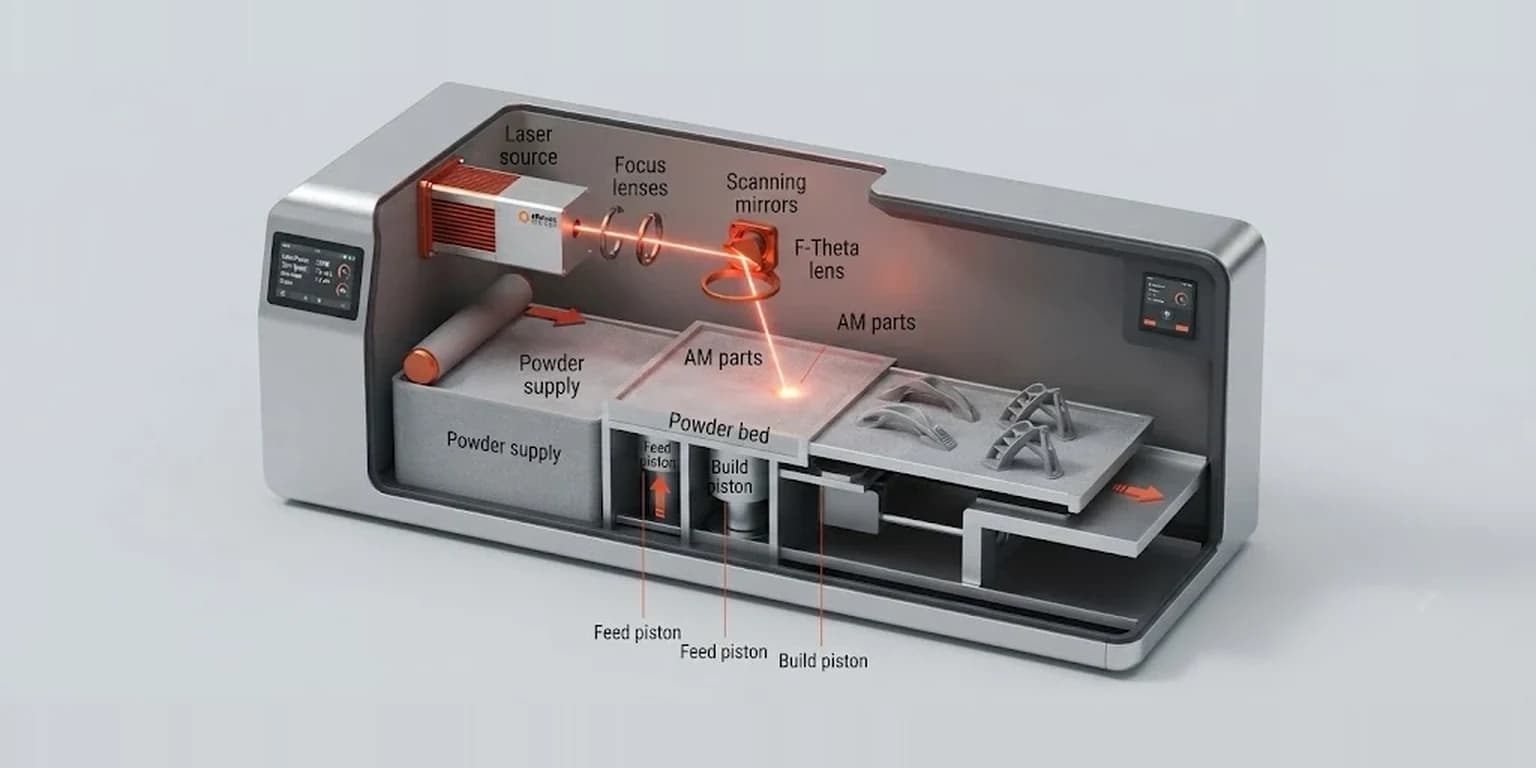
DED and L-PBF both produce metal parts additively, but they solve different problems. In L-PBF a recoater spreads a thin layer of powder across a build area and a laser melts the required cross-section. In DED, material is delivered directly into a melt pool only where deposition is needed.
| Factor | Directed Energy Deposition | Laser Powder Bed Fusion |
|---|---|---|
| Material supply | Wire or powder delivered to a melt pool | Powder spread across a build plate |
| Typical geometry | Larger, more open, near-net shapes | Fine features and complex geometries |
| Repairing existing parts | A major strength | Generally not the normal use case |
| Surface finish | Usually rougher as deposited | Generally finer, although finishing may still be needed |
| Internal lattices and small channels | Limited | Much better suited |
| Build scale | Can extend to very large systems | Limited by the powder-bed dimensions |
| Post-processing | Machining commonly planned from the start | Support removal, heat treatment and machining may be required |
A compact heat exchanger with fine internal passages is a good example of where L-PBF is the better starting point, because those features need powder-bed resolution. A worn edge on an expensive metal tool is a very different job: reprinting the whole tool would make little sense, while DED can add material only to the damaged region before final machining.
Process selection therefore comes down to geometry, size, material, required finish and what has to happen after printing. Our guide to laser powder bed fusion explains the powder-bed workflow in more detail.
What Materials Can Be Used in Directed Energy Deposition?
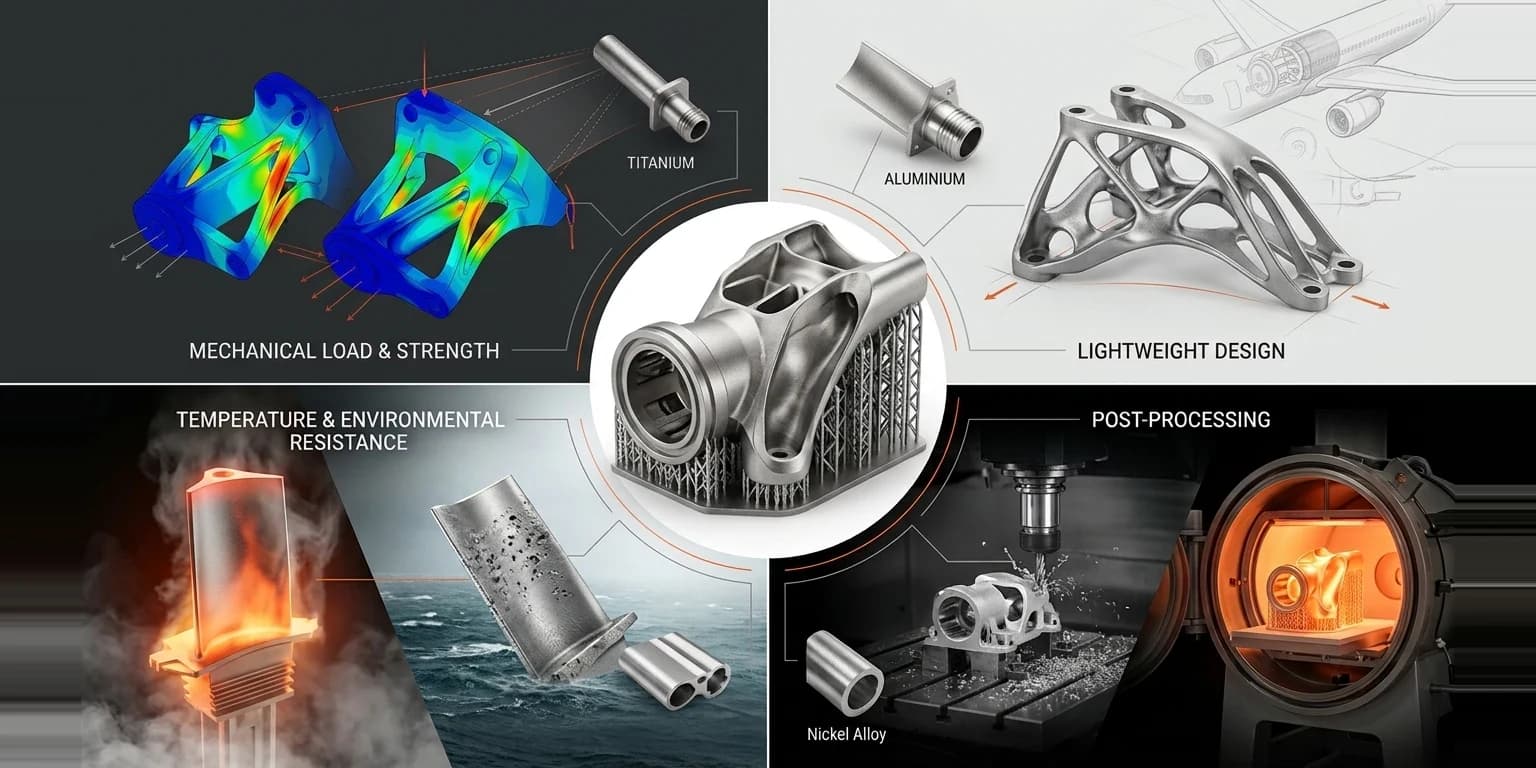
DED can process a wide range of engineering metals, but compatibility should always be checked for the specific machine, feedstock and parameter set. Common families include stainless steels, carbon and low-alloy steels, titanium alloys, nickel-based superalloys, tool steels, aluminium alloys and copper alloys.
Each brings different challenges. Titanium needs strong protection from oxidation at high temperature. Aluminium is demanding because of its oxide layer, reflectivity and high thermal conductivity, and hydrogen-related porosity can appear if moisture or contamination reaches the process. Copper reflects much of the light from common near-infrared fibre lasers and conducts heat quickly.
A material being available as wire does not automatically mean it is ready to print. Check wire diameter, surface condition, shielding requirements, available parameters, heat treatment and the properties that have actually been measured. For critical parts, appearance is only the first check: porosity, microstructure, build direction, oxygen content, heat treatment and inspection all influence final performance.
What Are the Advantages of Directed Energy Deposition?
Add material to existing components
DED can deposit onto an existing metal surface, supporting repair, refurbishment, feature addition and local reinforcement.
Build larger near-net shapes
Large DED systems are not restricted by a conventional powder bed. Depending on the machine, motion may come from a gantry, a CNC platform or a robotic cell.
Reduce unnecessary material removal
Instead of starting with a large billet and machining most of it away, DED can create a near-net form for finish machining. In aerospace this is often discussed as the buy-to-fly ratio: how much raw material is bought compared with the mass of the finished part. The actual saving still depends on the part and the finishing allowance.
Support cladding and local modification
A DED process can add a surface layer or rebuild a selected region without replacing the complete component.
Support research and hybrid manufacturing
Research-oriented platforms help teams study melt pools, bead geometry, thermal history and new materials, and some industrial systems combine deposition with machining in one workflow.
What Are the Limitations of Directed Energy Deposition?
Fine detail is limited
DED builds with deposited beads rather than very thin powder-bed layers, so small holes, delicate lattices and fine internal channels are difficult compared with L-PBF.
Surface finish is usually rougher
Visible deposition tracks are normal, so functional surfaces often need machining or grinding.
Heat can build up
Repeated heating can lead to distortion, residual stress and changes in microstructure if thermal conditions are not controlled.
Process parameters are strongly connected
Heat input cannot be considered on its own. Travel speed, feed rate, feedstock delivery, material and part temperature all interact, and changing one parameter can improve one part of the process while creating a problem elsewhere.
Access limits geometry
The deposition head and feedstock delivery need clear access to the build area, so deep enclosed features are difficult. Large unsupported overhangs and steep changes in build direction are also challenging, because the molten bead needs enough support while it solidifies. Multi-axis motion, part repositioning or specialised toolpaths extend what DED can produce, but they make process planning more complex.
Qualification still matters
A successful print is not automatically an acceptable engineering part. Critical work may still require heat treatment, material testing, dimensional inspection and non-destructive evaluation.
What Factors Affect Part Quality in Laser Wire DED?
Part quality comes from the balance between several settings, not from one headline number.
| Process factor | Why it matters |
|---|---|
| Laser power | Controls the energy available to form and maintain the melt pool |
| Travel speed | Changes interaction time and influences bead dimensions |
| Wire feed speed | Controls how much material enters the melt pool |
| Wire diameter | Affects material input, bead size and the available process window |
| Beam size and focus | Affect energy distribution and melt-pool size |
| Wire position and angle | Influence how consistently the wire enters and melts |
| Shielding gas | Protects hot metal from unwanted reaction with the atmosphere |
| Interpass temperature | Influences heat accumulation, cooling rate, distortion and microstructure |
| Bead overlap and toolpath | Affect layer uniformity, bonding and thermal history |
| Melt-pool monitoring | Gives evidence of process behaviour during deposition |
Laser power, travel speed and wire feed show how closely the settings are linked. If travel speed and wire feed are both increased to keep a similar amount of deposited material per unit length while laser power stays the same, less energy is available for that material, and the wire may fail to melt and fuse consistently.
Increasing laser power creates a larger, hotter melt pool, but more heat is not always better: it can increase bead spreading, dilution, distortion or heat accumulation. In repair and cladding work, dilution means more of the underlying material mixes into the deposited bead than intended. Parameter development is therefore about finding a stable processing window rather than maximising one setting.
Modern systems increasingly use cameras and other sensors to observe the melt pool. Monitoring does not by itself guarantee part quality, but it gives useful evidence about what happened during the build and can support future closed-loop control.
Where Is Directed Energy Deposition Used?
Repair and remanufacturing
DED can add new material to a worn region of a valuable component. Tooling, moulds, shafts and other high-value metal parts are common examples; the area normally needs preparation before deposition and finishing afterwards.
Surface cladding
A DED process can add a layer to improve wear, corrosion or other surface properties while retaining the component underneath.
Large near-net-shape components
DED is used for larger metal structures where producing the complete geometry inside a powder bed would be impractical. Large-scale systems may use gantries or robot arms to extend the working area.
Aerospace and energy
High-value components, expensive alloys and repair needs make these sectors important areas for DED development, although qualification requirements can be demanding.
Research and education
Universities use wire DED to study process parameters, bead formation, materials and melt-pool monitoring. A useful teaching experiment is to deposit three beads at three travel speeds while keeping the other approved settings constant, then compare bead width and height: it turns an abstract parameter into a result students can measure. Our guide to metal 3D printing in education covers training, process access, safety and supporting equipment for teaching labs.
When Does Wire DED Make Sense?
Wire DED deserves consideration when the application benefits from direct deposition and does not depend on very fine powder-bed geometry. Ask:
- Do you need to add metal to an existing component?
- Is a near-net shape followed by machining acceptable?
- Do you want to study wire feed, deposition strategy or melt-pool behaviour?
- Is solid wire a better fit for your laboratory or workshop workflow?
- Can the deposition head reach the required features?
- Can machining reach the surfaces that need tight tolerances?
- Do you need flexible parameters for research or development?
If the answer to most of these is yes, laser wire directed energy deposition is worth evaluating. If the part instead needs very fine features, small internal channels or lattice structures, L-PBF is the better starting point.
Where WireX Fits
For teams looking at compact wire-fed DED rather than a large robotic cell, WireX is built for research, education, prototyping and applied metal deposition. It is currently specified with:
- Up to 3000 W combined fibre laser output from a multi-laser platform
- A 150 × 150 × 150 mm build volume
- 0.4-0.8 mm wire diameter compatibility
- Three motion axes plus a synchronised wire-feed axis
- Integrated back-reflection melt-pool monitoring
- Support for carbon steel, stainless steel, titanium alloys and other suitable wire-available metals
- STL, STEP, IGS and CATIA file support
Those numbers only tell part of the story. For a researcher, melt-pool monitoring may matter as much as maximum laser power, because it gives visibility into deposition behaviour. For a university, solid wire also simplifies one part of feedstock handling compared with loose powder. WireX uses gas shielding around the deposition area, which matters especially for reactive alloys such as titanium.
Explore the WireX wire-fed DED printer
If the work depends more on fine features and powder-bed geometry, FusionX provides an L-PBF route. The two systems are different process choices for different parts and research goals.
Explore the FusionX L-PBF metal 3D printer
Final Thoughts
DED is useful when metal needs to be added directly where it is required rather than selectively melted within a powder bed. That can mean building a near-net shape, repairing a valuable component, adding a feature or running controlled deposition experiments.
Wire-fed DED can simplify feedstock handling, but the process still depends on a tight balance of heat, movement, wire delivery, shielding and thermal control, and machining, heat treatment and inspection are often part of the route as well.
If you are evaluating a DED system, start with the part or the experiment. Tell us the geometry, material, access, required finish, target properties and the process data you need, and those points will usually show whether wire DED, powder-fed DED, L-PBF or another route fits the job.

Additive Manufacturing and Structural Integrity at Lasefinity
Connect on LinkedIn